






Quick answer
BCAAs (branched-chain amino acids) include only three essential amino acids: leucine, isoleucine, and valine. EAAs (essential amino acids) include all nine essential amino acids your body needs.
EAAs are generally the better choice than BCAAs alone because muscle protein synthesis (MPS) requires a complete supply of all 9 essential amino acids. BCAAs can support training in some contexts, but without the other six EAAs, they may not provide the full
building blocks needed to build new muscle tissue.
Key takeaways
- BCAAs contain only 3 amino acids (leucine, isoleucine, valine); EAAs contain all 9 essential amino acids.
- Leucine is a key trigger for muscle protein synthesis signaling, but building new muscle tissue requires all essential amino acids.
- BCAAs can be useful in some contexts, but BCAAs alone may be limited for muscle building because they don’t supply the full set of EAAs.
- For low-calorie support, look for an EAA supplement with a complete 9-EAA profile in research-backed ratios, with additional leucine and minimal sugar/stimulants.
BCAAs vs EAAs (Essential Amino Acids): Which is better?
Amino acids are one of the most studied supplements of the last 40 years. Of the many aminos acid supplements available, branched-chain aminos (BCAAs) are the most popular amongst athletes. Some performance athletes swear by their benefits for muscle gain, recovery, and athletic performance.
But BCAAs are not as great for muscle building and performance as you've been lead to believe.
Some research suggests that BCAAs taken in isolation may be less effective for supporting muscle-building than a full EAA profile, and elevated BCAA levels have been associated with metabolic risk in observational research.1
So, if BCAAs aren’t all they're cracked up to be for performance or building muscle, why all the hype?
And, more importantly, what is the best supplement for performance and building muscle?
This is where Essential Amino Acids (EAAs) come in. Scientific literature backs them up as one of the best supplements you can take to enhance your overall health, athletic performance, and recovery.
What are amino acids?
But First, What Exactly Are Amino Acids?
Amino acids are the building blocks of protein. They act as the catalyst for nearly every chemical process in your body. They support processes like protein synthesis, muscle gain, brain function, hormone regulation, metabolism, and more. There are 20 amino acids in total, and all of them are necessary to make the magic happen for your health and performance.
What are EAAs (essential amino acids)?
Okay, so what are EAAs and how can they help me?
Essential amino acids are amino acids that your body can’t make on its own—and therefore must be consumed through diet or supplementation.
They are found in protein-rich foods like meat, fish, and eggs, and of course, amino acid supplements.
Instead of thinking about each essential amino acid as a separate “magic ingredient,” it’s more accurate (and more useful) to think about EAAs as a complete set your body needs to build and repair proteins.
As a group, essential amino acids help your body:
- Build and repair muscle tissue (muscle protein synthesis)
- Maintain lean mass when training hard, dieting, or training fasted
- Produce enzymes and other functional proteins involved in energy metabolism and recovery
- Support high-turnover tissues (like the gut and immune system) that rely on steady protein turnover
When you consume EAAs, you increase the availability of the full set of building blocks in the bloodstream, which can support muscle protein synthesis more effectively than providing only a partial amino acid profile.
The nine essential amino acids are: leucine, isoleucine, valine, lysine, methionine, phenylalanine, threonine, tryptophan, and histidine.


Do BCAAs build muscle on their own?
Back to BCAAs for a Moment
The popular benefits that many people associate with BCAAs, like muscle growth and performance enhancement, are often overstated, misunderstood, and sometimes flat-out wrong.
This is because your body needs all 9 EAAs, and BCAAs contain only 3 of the 9. Without having all of the EAAs available from diet, the body may draw on internal amino acid pools to complete protein synthesis, which can limit the muscle-building effect of BCAAs alone.
A meta-analysis of research conducted between 1985 and 2017 revealed zero human studies in which BCAAs alone were responsible for more efficient protein synthesis or improved athletic performance.2
In fact, the meta-analysis discussed two studies that found that BCAAs actually decreased muscle protein synthesis and instead increased the catabolic rate of lean tissue. This means that muscle was being broken down faster than it was repaired.
In other words, BCAAs don’t work on their own. All 9 EAAs are necessary to complete protein synthesis and muscle growth.
The study concluded that the idea that BCAA supplements alone stimulate muscle growth or produce an anabolic response is entirely untrue. And that’s just the beginning. In addition to being ineffective for building muscle or faster recovery, BCAAs can also have a negative impact on one’s overall health:
BCAA metabolism relies on several B-vitamin–dependent pathways. With very high BCAA intake (especially without adequate overall nutrition), demand for certain B vitamins may increase.3 B-vitamin insufficiency can disrupt many biological functions, including digestion, nervous system function, brain health, and hormone production.
Because BCAAs and tryptophan share transport mechanisms to enter the brain, very high BCAA intake may influence tryptophan availability in some contexts.4 Tryptophan is a precursor to serotonin, so shifts in availability can matter for mood and sleep signaling.
Elevated BCAA levels are associated with insulin resistance and metabolic risk in observational studies,5 and some research suggests they may predict the development of type 2 diabetes in certain populations.6 Context matters (overall diet, body composition, and activity level).
EAAs for muscle, aging, and body composition
Why EAAs Are Crucial for Building Muscle
Even though BCAAs are still essential for human health and actually serve as a good source of fuel for workouts, they simply don’t build muscle without the help of EAAs. Here’s how EAAs can support you in ways that BCAAs cannot:
Muscle Maintenance: The amino acid Leucine, in particular, has been shown to be crucial in promoting gains in fat-free mass and muscle mass, which is why it is important to look for an EAA supplement enriched with extra leucine. The full spectrum of EAAs help preserve muscle mass, especially when training in a fasted state. They help decrease muscle damage and promote a healthy inflammatory response.7
Exercise Recovery: Supplementing with EAAs after working out increases muscle protein synthesis and helps grow muscle mass. This may support faster recovery and less fatigue after training.8
Appetite Regulation: Having the right balance of amino acids may help with appetite and hunger pangs because EAAs activate the brain cells that regulate hunger and feelings of fullness.9 10
Aging populations: As we get older, it can become harder to maintain muscle and strength (especially if training volume drops or protein intake is inconsistent). Getting enough essential amino acids can help support muscle maintenance and recovery, particularly when paired with resistance training.
Caloric Restriction: When appetite is reduced (or calories are restricted) from dieting or GLP-1/Semaglutide use, it’s easier to under-eat protein. And in a calorie deficit, the goal of preserving lean mass can make it even more important to consistently meet your essential amino acid needs (because you’re getting fewer total amino acids from food). A full-spectrum EAA supplement can be a low-calorie way to help cover essential amino acid needs and support lean mass while dieting or using appetite-suppressing medications.
How to choose an EAA supplement
Finding a quality EAA supplement can prove to be challenging. Many EAA supplements are missing crucial EAAs, have added sugar, stimulants, artificial ingredients, or extra calories, or don't disclose exactly how much of each EAA is in their formula.
Here’s a quick checklist to help you evaluate any EAA product:
- Transparent label: lists the full amino acid profile and the grams per serving
- Complete 9-EAA formula: includes all nine essential amino acids (not just BCAAs)
- Clear leucine amount: states leucine content and is ideally 40% of the total formula
- Minimal “extras”: no unnecessary sugar, stimulants, or filler ingredients (unless you specifically want them)
- Quality controls: look for third-party testing and reputable manufacturing standards
Kion Aminos
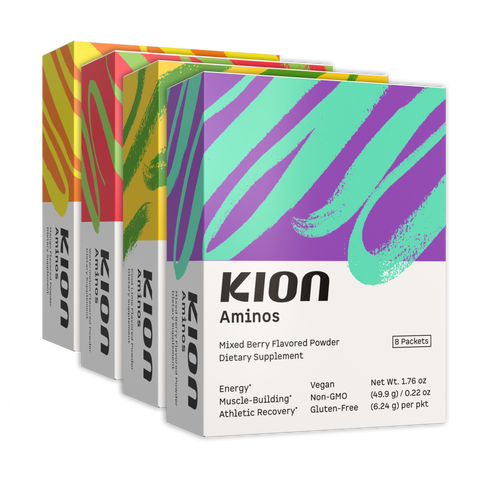
Kion Aminos contains all 9 EAAs (with amounts of each listed clearly, down to the milligram), contains 40% leucine, and is based on over 30 years of peer-reviewed clinical research.
“Since taking Kion Aminos I notice more energy during my workouts and less soreness after my workouts. I enjoy them so much I have recommended them to others in my gym.”
Vince M (verified buyer)

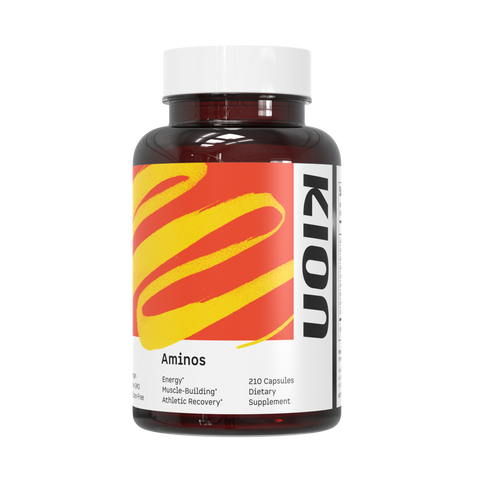
Plus, Kion Aminos comes in four delicious flavors (Mango, Watermelon, Mixed Berry, and Cool Lime), as well as unflavored Capsules and Travel Packets.
Better Aminos

Scientific Research
- https://www.ncbi.nlm.nih.gov/pmc/articles/PMC5568273/
- https://jissn.biomedcentral.com/articles/10.1186/s12970-017-0184-9
- https://link.springer.com/chapter/10.1007/978-1-4939-1923-9_2
- https://www.ncbi.nlm.nih.gov/pubmed/16424144
- https://www.ncbi.nlm.nih.gov/pubmed/27376324
- https://www.ncbi.nlm.nih.gov/pmc/articles/PMC3126616/
- https://www.ncbi.nlm.nih.gov/pubmed/3316914
- https://www.physiology.org/doi/full/10.1152/ajpendo.00466.2001
- https://www.ncbi.nlm.nih.gov/pmc/articles/PMC5404834/
- https://www.sciencedirect.com/science/article/pii/S2212877817305379


Comments
Great article!
Jake on
Hello,
I found your article to be very informative. I have one question, when is the best time to take Aminos Powder? Before or after a workout or anytime?
Thank you!
Stacey
Stacey Fujiwara on
I am interested in the references cited in this article. Can you provide a reference list of the items that are cited in this article. Thank you.
———
Kion replied:
Hello, At the bottom of the the page, just above the comment section, you will find a list of all supporting studies for any claim. Should you desire to dive deeper into a specific point, reach out to our support team on [email protected] and we’ll be happy to discuss.
Michael R Grigsby on
Is it possible to get a version without stevia etc?
———
Kion replied:
You’ll find the exact same EAA content and ratios here: https://getkion.com/products/aminos-capsules
Natalia on
Thank you Ben, as always the articles that you present are educational.
Ruby on